

Effective Organizations like Healthy Families
Tolstoy began his novel Anna Karenina with the immortal words :
Happy families are all alike; each unhappy family is unhappy in its own particular way
And so it may be with organizations: they have an unlimited variety of ways to fail, but perhaps only few by which to succeed.
In the spirit of Tolstoy, I will not try to list all these ways to fail—blogs have their limits—but present a framework by which many seem to get it right.
Lewis et al., in the introduction to their book No Single Thread: Psychological Health in Family Systems¹, comment that: “There is considerable literature on the pathological family types, but a ‘scarcity of data’ on the healthy family” (1976: xvii).
When I read the book, I was struck by the parallels with a framework that I had already sketched out in my book Managing. I subsequently borrowed the word “thread”, and was able to find one or more quotes from their book that matched each of the characteristics that I had identified in effective organizations.
So here comes, not a formula, not a theory, not a set of propositions, so much as a tapestry to appreciate effectiveness in organizations. As shown in the figure, at the center are five threads, what we call managerial mindsets in our International Masters Program for Managers.²
They range from the more personal to the more social and are labelled reflective, analytic, worldly, collaborative, and proactive. Two additional threads are shown: at the beginning that of being personally energetic, and at the end that of being socially integrative. Each thread is discussed in turn.
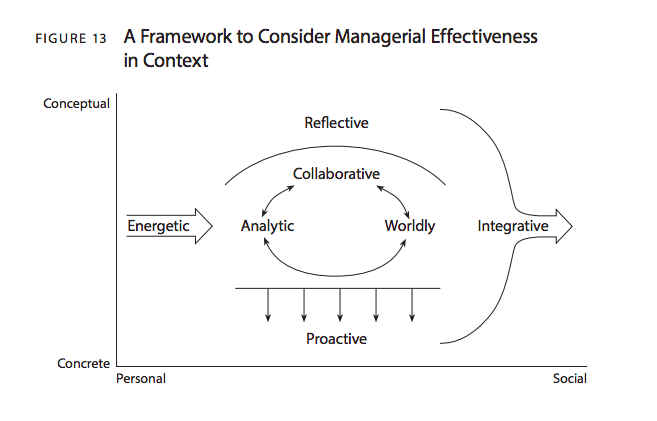
The Energetic Thread
“Although [effective] families differ in the degree of energy displayed, they all demonstrated more constructive reaching out than did patently dysfunctional families” (p. 208–209). Effective organizations may likewise differ in the energy they display, but perhaps not in their inclinations for constructive “reaching out.”
The Reflective Thread
“In approaching problems within the family, [the healthy ones] explored numerous options; if one approach did not work, they backed off and tried another. This was in contrast to many dysfunctional families in which a dogged perseverance with a single approach was noted” (p. 208).
In my own experience, a remarkable number of effective organizations, and their managers are reflective: they know how to learn from their own experience; they explore numerous options; and they back off when one doesn’t work, to try another. They are inclined to know what they know while appreciating what they don’t know.
_____
READ ALSO: HENRY MINTZBERG ABOUT SOME HALF-TRUTHS OF MANAGEMENT
_____
As I noted in my book Managers not MBAs, reflecting means “wondering, probing, analyzing, synthesizing, connecting—‘to ponder carefully and persistently [the] meaning [of an experience] to the self’.”³
This goes beyond sheer intelligence, to a deeper wisdom that enables people to be insightful—to see inside issues, beyond their obvious perceptions. Many of the people in effective organizations think and see for themselves.
The Analytic Thread
Too much attention to analysis can be dysfunctional in organizations, but so too can too little, leading to disorganization.
Looking for the key to effectiveness in the light of analysis may be misguided, but expecting to find it in the obscurity of intuition is no more sensible. People have to know formally and explicitly as well as informally and tacitly.
Lewis et al. describe the most dysfunctional families as presenting “chaotic structures” and what they call the midrange families as presenting “rigid structures,” while the “most competent families presented flexible structures” (p. 209).
The Worldly Thread
“There is another complex family variable that involves respect for one’s own worldview as well as that of others” (p. 207). We hear a great deal these days about globalization, but not much about worldliness. To be global implies a certain conformity. Is this what we want from our managers?
_____
READ ALSO: HENRY MINTZBERG ABOUT SPECIES OF ORGANIZATIONS
_____
Thinking for ourselves requires that we be worldly, which is defined in my dictionary as “experienced in life, sophisticated, practical.” An interesting mixture of words—and perhaps as close as a set of words can get to what many of us want from our organizations. (See my earlier blog on this.)
To be worldly means to get into the worlds of other people—other cultures, other organizations, even other functions within our own organization. To paraphrase a line by T. S. Eliot that has been overused for good reason, people should be exploring ceaselessly in order to return to where they started and know the place for the first time. This is the worldly mindset.
To appreciate other people’s worlds does not mean to invade their privacy, or “mind-read” them. Lewis et al. found these to be “destructive characteristics”, seen only in “the most severely dysfunctional families” (p. 213).
In the midrange families, they found pressures for conformity. But in the healthy families, these researchers found what they called “respectful negotiation…. There was no tidal pull toward a family oneness that obliterates individual distinctions” (p. 211).
The Collaborative Thread
As we move along our tapestry, the social aspects of organizing become more prominent. Collaboration is not about motivating or empowering people, but about helping them to function together.
“The trend toward an egalitarian marriage was in striking contrast to both the more distant (and disappointing) marriages of the adequate families and the marital pattern of dominance and submission that so often was seen in dysfunctional families” (p. 210).
Healthy organizations exhibit a sense of respecting, trusting, caring, and inspiring, not to mention listening. To draw more from the Lewis et al. book, “Healthy families were open in the expression of affect. The prevailing mood was one of warmth and caring. There was a well-developed capacity for empathy” (p. 214).
These days, we hear a good deal about teams and task forces, networking and learning organizations, joint ventures and alliances. Many “subordinates” have become colleagues and many suppliers have become partners.
All this requires a shift in managerial styles from controlling to collaborating, leading to linking, empowering to engaging.
The Proactive Thread
“There was little that was passive about healthy families. The family as a unit demonstrated high levels of initiative in responding to input” (Lewis et al., p. 208–209).
All managerial activity is sandwiched between reflection in the abstract and action on the ground—“refl’action” is a word coined by one of our IMPM participants. Nothing gets done when there is too much reflection, while things get done thoughtlessly when there is too much action.
I have saved this for last among the five mindsets because, while reflection can be largely personal, action in organizations is fundamentally social: it cannot happen without the involvement of various people.
Managers who try to do it alone typically end up over-controlling—issuing orders and deeming performance in the hope that authority will ensure compliance. Effective managing is essentially a social process.
I use the term proactive rather than active to indicate that this thread is about seizing the initiative—launching action instead of just responding to what happens.
Doers grab whatever degrees of freedom they can get and run vigorously with them. To quote Isaac Bashevis Singer in what could be the motto of the effective organization:
“We have to believe in free will; we’ve got no choice.”
The Integrative Thread
Lewis et al.’s most important conclusion may be:
“…health at the level of family was not a single thread… competence must be considered as a tapestry” (p. 206).
Effective organizing is a tapestry woven of the threads of reflection, analysis, worldliness, collaboration, and proactiveness, all of it infused with personal energy and bonded by social integration.
Effective organizations harness the “collective mind.”
© Henry Mintzberg 2018. Derived from passages in my books Managing and Simply Managing.
————————–
¹Lewis, J.M., Beavers, W.R., Gossett, J.T., & Phillips, V.A. (1976). No Single Thread: Psychological Health in Family Systems. New York: Brunner/Mazel
²Gosling, J., & Mintzberg, H. (2003). Five Minds of a Manager. Harvard Business Review, 81(11), 54-63
³Mintzberg, H. (2004). Managers, Not MBAs: A Hard Look at the Soft Practice of Managing and Management Development. San Francisco: Berrett-Koehler. Citing Daudelin, M.W. (1996). Learning from Experience Through Reflection. Organizational Dynamics, 24(3), 41.
____
Thank you, Henry Mintzberg, for sharing your words with us. As always we encourage our readers to visit your BLOG at Mintzberg.org
180517